Modern electronics continue to become smaller, faster, and more powerful thanks to continuous advancements in PCB assembly. From smartphones to industrial automation systems, almost every electronic device relies on advanced manufacturing techniques for reliable performance. During PCB assembly, the terms SMD and SMT are often used interchangeably, which can create confusion among engineers, designers, purchasing teams and product developers.
Understanding the difference between SMD and SMT helps businesses make informed manufacturing decisions and communicate more effectively with their PCB assembly partner. While the terms sound similar, they refer to different aspects of the electronics manufacturing process. In this guide, you’ll learn what SMD and SMT are, how they differ, how they work together, their advantages in PCB assembly and why choosing an experienced manufacturing partner is essential.
What is SMD in Electronics?
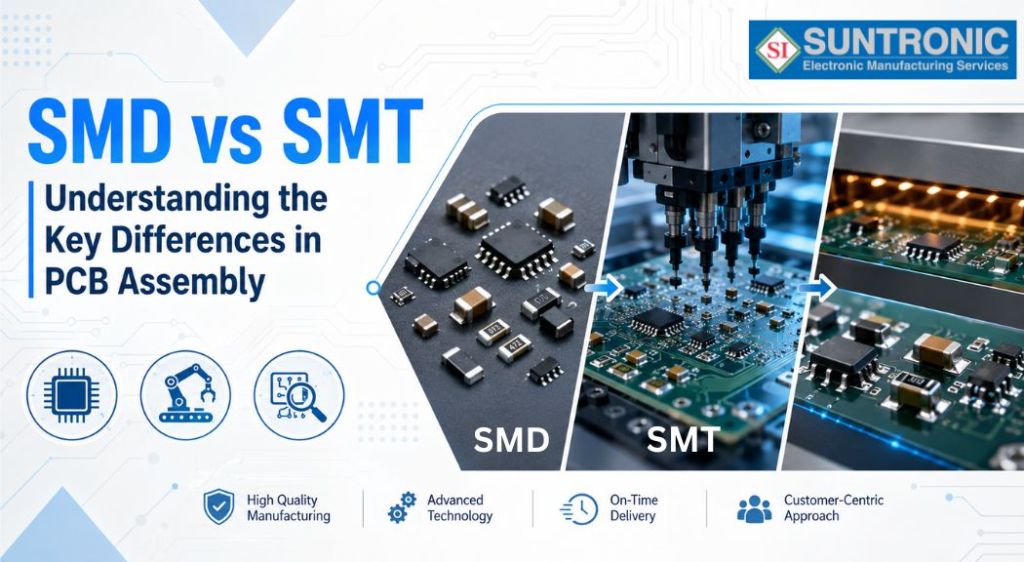
SMD stands for Surface Mount Device. It refers to the electronic components that are directly mounted onto the surface of a printed circuit board instead of passing through drilled holes.
Common SMD components include:
- Resistors
- Capacitors
- Integrated Circuits
- LEDs
- Diodes
- Transistors
- Connectors
These components are manufactured in compact sizes allowing engineers to design smaller more efficient electronic products without sacrificing performance.
Today almost every modern PCB uses Surface Mount Devices because they occupy less board space support higher component density improve electrical performance reduce overall product size. When discussing smd and smt it is important to understand that SMD represents the physical electronic component used during assembly.
What is SMT in Electronics?
SMT stands for Surface Mount Technology. It is the automated manufacturing process used to place solder inspect reflow SMD components onto a printed circuit board.
The SMT process typically includes the following steps:
- PCB preparation
- Solder paste printing
- Automated component placement
- Reflow soldering
- Automated Optical Inspection
- X Ray inspection when required
- Functional testing
Modern SMT production lines use advanced pick and place machines capable of placing thousands of components every hour with exceptional accuracy.
Understanding smd and smt becomes much easier when you remember that SMT is the complete manufacturing technology while SMD refers to the electronic devices installed using that technology.
SMD vs SMT : Key Differences
Understanding the key differences between SMD (Surface Mount Device) and SMT (Surface Mount Technology) is essential for efficient PCB design and assembly. This comparison clarifies their roles, helping engineers, manufacturers, and buyers make informed decisions and communicate more effectively throughout the electronics manufacturing process.
Feature | SMD | SMT |
Full Form | Surface Mount Device | Surface Mount Technology |
Definition | Electronic component | Manufacturing process |
Purpose | Performs electrical function | Mounts components onto PCB |
Examples | IC resistor capacitor LED | Solder paste printing pick and place reflow |
Category | Hardware component | Assembly technology |
Role in PCB Assembly | Installed on PCB | Installs SMD components |
Simply explained the discussion around smt vs smd is about the relationship between components and manufacturing technology rather than competing options.
How SMD and SMT Work Together
Modern PCB assembly depends on both SMD components and SMT manufacturing technology working together throughout production.
The process begins with PCB fabrication followed by solder paste application. High speed placement machines then accurately position each SMD component onto the solder paste. After placement the PCB enters the reflow oven where controlled heating permanently bonds each component to the board. Inspection testing quality verification complete the manufacturing process before shipment.
Without SMT technology manufacturers could not efficiently assemble modern electronic products using miniature Surface Mount Devices. Likewise SMT would have no purpose without SMD components ready for placement.
This explains why smd and smt are complementary rather than interchangeable terms. Every successful PCB assembly relies on both working together to achieve reliable performance consistent quality high production efficiency.
Advantages of SMD and SMT in PCB Assembly
The combination of advanced Surface Mount Devices (SMDs) and automated Surface Mount Technology (SMT) has transformed electronics manufacturing across nearly every industry.
- Smaller Product Designs
SMD components require very little board space, allowing designers to develop lightweight, compact electronic products.
- Faster Manufacturing
Automated SMT production lines can place thousands of components every hour, improving production speed, reducing lead times, and increasing manufacturing efficiency.
- Higher Reliability
Accurate automated component placement minimizes assembly errors, improves solder joint consistency, and increases long-term product reliability.
- Better Electrical Performance
Shorter electrical paths reduce signal interference, improve circuit speed, and enhance overall electronic performance.
- Lower Manufacturing Cost
Automation reduces labor requirements, minimizes material waste, and improves production consistency, resulting in lower overall manufacturing costs.
- Higher Component Density
More electronic components can fit within smaller PCB layouts, supporting increasingly complex electronic designs.
Businesses comparing SMD vs SMT often discover that neither replaces the other. Instead, both work together to improve manufacturing quality, production efficiency, and overall product performance.
Choosing the Right PCB Assembly Partner
Selecting the right PCB assembly manufacturer directly impacts product quality manufacturing consistency project success.
When evaluating an assembly partner consider the following capabilities.
- Modern SMT production equipment
- Engineering support for DFM DFT DFX
- Prototype low volume medium volume high volume manufacturing
- Automated Optical Inspection
- X Ray inspection
- Functional testing
- Quality certifications
- Reliable component sourcing
- Supply chain management
- Fast production turnaround
An experienced manufacturing partner can identify design challenges before production optimize manufacturing efficiency improve product reliability reduce overall production costs.
At Suntronic, our experienced engineering and manufacturing teams provide complete PCB assembly services, from rapid prototyping to full-scale production. In addition to advanced assembly solutions, we also offer PCB Conformal Coating services to enhance the protection and reliability of electronic assemblies. Our advanced SMT manufacturing capabilities, combined with rigorous inspection, testing, and quality control, ensure that every assembled and coated PCB meets the highest industry standards.
Whether your project requires prototypes complex multilayer assemblies high volume production custom electronics manufacturing Suntronic delivers dependable solutions designed around quality precision customer satisfaction.
Conclusion
Understanding the difference between SMD and SMT is essential for successful PCB assembly. SMD refers to the electronic components, while SMT is the technology used to mount those components onto the PCB. Knowing the difference helps improve communication, manufacturing decisions, and product development.
When comparing SMD vs SMT, remember that one is the component and the other is the assembly process. As electronics continue to evolve, SMT remains the preferred manufacturing method due to its speed, accuracy, reliability, and cost-effectiveness. Partnering with an experienced PCB assembly company like Suntronic ensures high-quality and reliable electronic assemblies from prototype to production.

David Ly
David Ly is the Chief Operating Officer (COO) at Suntronic Incorporated, a prominent electronics manufacturing services (EMS) provider headquartered in Richardson, Texas. He leads the company's daily operations, strategic business objectives, and technology-driven product development.