Imagine this: you are designing a state-of-the-art electronic device, one that needs to perform flawlessly in tough conditions, including extreme temperatures, humidity, dust, or chemicals. But there’s one thing standing between you and perfect performance: the vulnerability of your Printed Circuit Boards (PCBs). What if you could add a layer of protection to ensure these delicate circuits thrive in even the harshest environments?
As a leading provider of PCB assembly services, Suntronic understands the crucial need for reliable, long-lasting PCBs. To achieve this, we utilize one of the most reliable methods—conformal coating, which provides essential protection against environmental threats. Let us now understand why conformal coating is so essential when it’s needed and how it can significantly improve the performance and lifespan of your PCBs.
What is Conformal Coating?
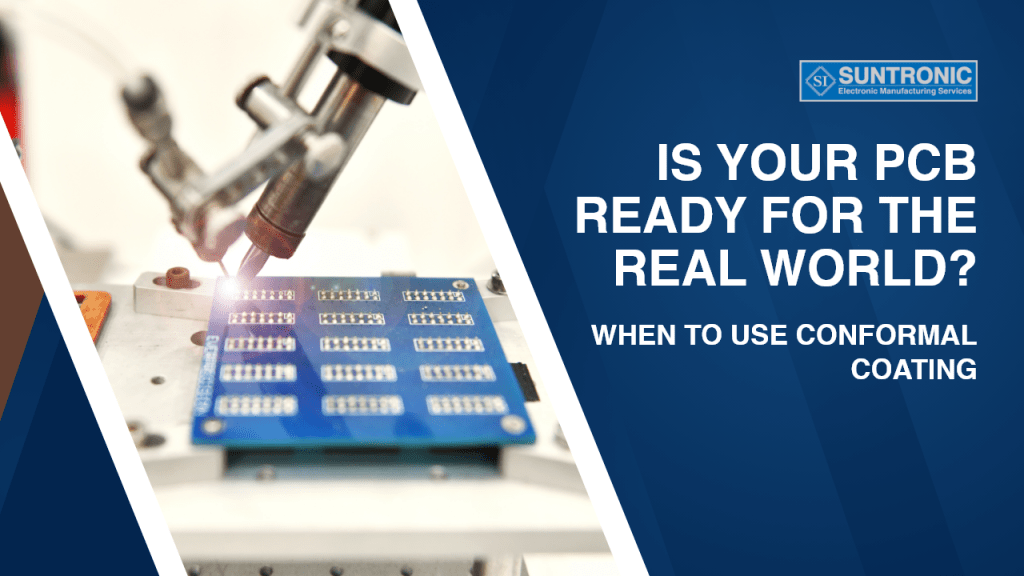
Conformal coating is a protective layer applied to PCBs to shield them from external environmental factors. Its purpose is simple: to enhance the durability and longevity of PCBs by providing a barrier against moisture, dust, chemicals, and temperature fluctuations. This coating can be applied in various forms, ensuring that your PCBs remain functional and reliable in a range of challenging environments.
There are several types of conformal coatings available, each with its unique properties. Some of the most common types include:
- Polyurethane Coatings: They ensure great chemical resistance and can withstand mechanical stresses.
- Epoxy Coatings: These coatings create a strong, rigid protective layer that is ideal for high-stress environments.
- Acrylic Coatings: These coatings are known for their ease of application and excellent dielectric properties.
- Silicone Coatings: These coatings are best for high-temperature and harsh environmental conditions.
How Conformal Coating Improves PCB Performance
PCB Conformal coating does more than just protect against environmental elements, it actively enhances the overall performance of PCBs. Here are a few ways it contributes to the performance of your circuit boards:
- Prevents Short Circuits and Electrical Failures: Moisture and contaminants can cause electrical shorts or failures, but conformal coating provides an extra layer of protection to prevent this.
- Enhances Insulation Properties: The coating increases the insulation resistance of PCBs, which is especially crucial in sensitive electronic applications.
- Improves Resistance to Vibrations and Mechanical Stress: In industries such as automotive and aerospace, where vibrations and mechanical stresses are common, conformal coating provides the resilience necessary to keep the PCBs functioning properly.
- Protects Against Environmental Factors: Whether it is moisture, dust, chemicals, or extreme temperatures, conformal coating acts as a barrier that protects the delicate components of your PCBs from these harmful elements.
- Increases Longevity and Reliability: By preventing wear and tear, conformal coating extends the life of your PCBs, making them more reliable in the long run.
Key Situations When Conformal Coating is Necessary
There are certain circumstances where conformal coating becomes a must for your PCBs. Here are some key situations where applying conformal coating is highly beneficial:
- Harsh Environments: Conformal coating provides much-needed protection for PCBs used in environments with high humidity, extreme temperatures, or exposure to chemicals.
- High-Humidity and Condensation-Prone Areas: Electronics used in humid and condensation-prone areas are vulnerable. Coating helps prevent corrosion and dendritic growth that can cause short circuits in the PCB.
- High-Voltage and High-Density Designs: The printed circuit boards with high component density or high-voltage sections are prone to crosstalk or arcing. A conformal coating helps insulate these areas and prevent unintentional electrical paths.
- Mission-Critical Applications: Conformal coating adds a layer of compliance and reliability in applications, such as defense electronics, medical devices, or aerospace systems, where failure isn’t an option.
- Chemical-rich Industrial Environments: PCBs used in electronics operated in industrial environments may face oils, vapors, and corrosive chemicals. Polyurethane or silicone coatings are useful in these environments due to their excellent chemical resistance.
When You Should Skip Using Conformal Coating on PCBs
Although conformal coating is highly beneficial in many scenarios, there are situations where it may not be necessary. Here are a few instances where you might skip using conformal coating:
- Low-Stress Applications: Extra protection may not be needed for PCBs operating in low-stress environments, where there’s little risk of environmental exposure.
- Impact on Heat Dissipation: In some sensitive circuits where heat dissipation is crucial, applying a conformal coating can affect the PCB’s thermal management, making it less effective in dissipating heat.
- Controlled Environments: If your PCBs are used in a controlled environment with stable temperature and humidity, such as indoor electronics with minimal exposure to harsh elements, the conformal coating may not be required.
- Short Lifecycle or Disposable Products: If your product is designed for short-term use, such as single-use electronics, medical test kits, or rapid prototypes, coating may not be necessary.
- High Rework or Testing Needs: Conformal coating makes repair, inspection, and solder touch-ups difficult for boards that require manual testing, frequent probing, and late-stage revisions. So, leaving them uncoated improves accessibility.
Choosing the Right Conformal Coating for Your PCB
Selecting the correct conformal coating is essential to ensure that your PCB is adequately protected. Several factors influence this decision, including:
- Material Compatibility: It’s important to choose a coating that is compatible with the materials used in your PCB. This ensures proper adhesion and effective protection.
- Environment: Consider the environment in which the PCB will operate. Different coatings offer varying levels of resistance to heat, moisture, and chemicals, so it’s crucial to select one that matches the conditions.
- Ease of Application: Some coatings are easier to apply than others, and the application method may also influence the overall cost and efficiency of the coating process.
Why Choose Suntronic for Conformal Coating?
At Suntronic, we don’t just assemble PCBs; we help protect them for the long haul. Our team evaluates your board design, environment, and performance goals to recommend the best conformal coating solution. Whether you need selective coating, full-board protection, or help navigating IPC-CC-830 standards, we have got you covered.
From prototyping to full-scale production, we ensure every board we build performs exactly as intended, no matter where it ends up.