PCB manufacturing requires high accuracy at every step, because even minor imbalances can cause noticeable defects. One common problem in surface mount technology is pcb tombstone, where components do not sit properly during soldering.
Understanding pcb tombstoning, along with its causes and prevention methods, is important to maintain good assembly quality and ensure long-term reliability of electronic products.
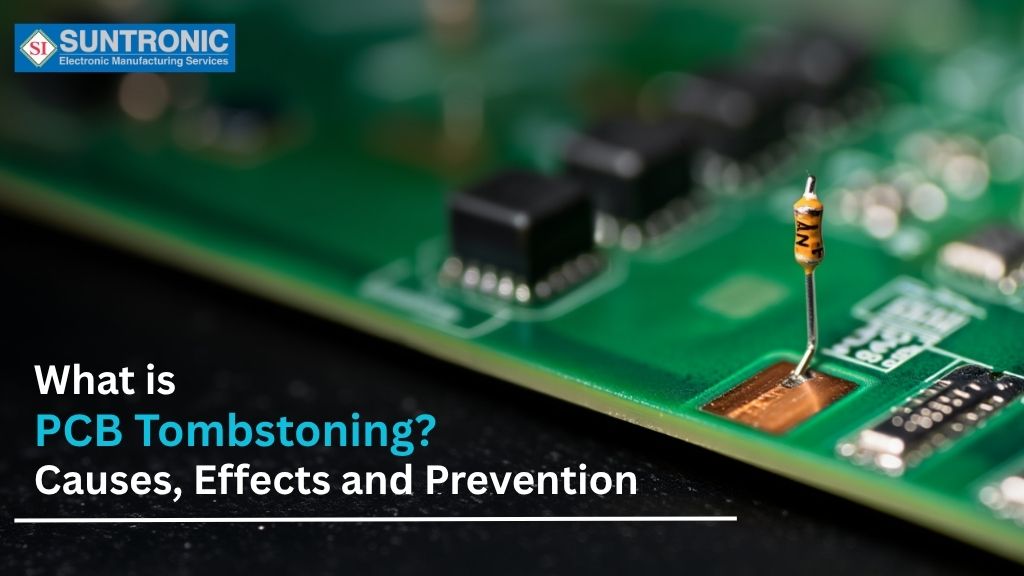
What is PCB Tombstoning in PCBs?
PCB tombstone refers to a defect where a surface-mounted component lifts from one side and stands upright during soldering, resembling a tombstone. This issue typically occurs in small passive components like resistors and capacitors.
In pcb tombstoning, one end of the component gets soldered properly while the other end lifts due to uneven forces during reflow. This imbalance leads to improper electrical connections and affects overall circuit functionality. During tombstoning pcb assembly, this defect is often identified after the reflow process, making it a critical concern in surface mount technology (SMT) production lines.
Why Tombstoning Occurs in PCBs?
The main reason behind a tombstone defect in pcb is an imbalance in soldering forces. When both pads of a component do not heat or melt uniformly, surface tension pulls the component unevenly.
Several key factors contribute to pcb tombstoning:
- Uneven heating: One pad reaches melting temperature faster than the other
- Surface tension imbalance: Molten solder pulls more strongly on one side
- Thermal mismatch: Differences in pad size or copper distribution affect heat absorption
These issues combine to create the tombstone effect pcb, where the component tilts or stands upright instead of sitting flat on the board.
Causes of PCB Tombstone Defect
Understanding the root causes of pcb tombstone defects helps manufacturers take corrective action. Below are the most common causes of tombstone defect in pcb:
Cause | Description | Impact |
Improper solder paste | Uneven or excessive paste on one pad | Creates unequal surface tension |
Poor pad design | Unequal pad sizes or shapes | Causes uneven heating |
Component misalignment | Incorrect placement during pick-and-place | Leads to imbalance during reflow |
Thermal imbalance | Uneven copper distribution on PCB | Affects heat flow |
Reflow profile issues | Incorrect temperature ramp or soak time | Results in uneven solder melting |
Each of these factors can contribute to pcb tombstoning and increase the likelihood of defects during tombstoning pcb assembly.
How PCB Tombstone Defects Occur in SMT Assembly
During SMT processes, solder paste is applied to pads and components are placed using automated machines. The board then passes through a reflow oven where the solder melts and solidifies.
A tombstone defect in pcb typically occurs during this reflow stage. If one pad heats faster, the solder on that side melts first and creates a pulling force. This force lifts the component before the second pad’s solder melts.
This phenomenon is known as the tombstone effect pcb and it is especially common in small components like 0402 or 0201 sizes. In tombstoning pcb assembly, even slight variations in temperature or paste volume can trigger this defect.
The Impact of Tombstoning on PCB Assembly
The pcb tombstone defect can have serious consequences on the performance and reliability of electronic devices.
Here are the key impacts of pcb tombstoning:
- Open circuits: One side of the component is not connected
- Signal loss: Interruptions in current flow affect circuit performance
- Manufacturing defects: Increased rejection rates and rework costs
- Reduced reliability: Weak connections may fail over time
The tombstone effect pcb not only affects electrical functionality but also increases production time and cost. In high-volume tombstoning pcb assembly, this can significantly reduce yield and efficiency.
How to Prevent PCB Tombstoning
Preventing pcb tombstone defects requires careful control over design, materials and process parameters.
Here are the best practices to minimize pcb tombstoning:
- Optimize pad design: Ensure both pads are symmetrical in size and shape
- Control solder paste application: Use accurate stencil design and printing techniques
- Improve component placement: Ensure precise alignment during pick-and-place
- Balance thermal profile: Use uniform heating in the reflow oven
- Use proper reflow settings: Optimize ramp rate, soak time and peak temperature
By addressing these factors, manufacturers can reduce the chances of tombstone defect in pcb and improve overall assembly quality.
How Suntronic Prevents Tombstoning During Selective Soldering
Selective soldering needs careful control to avoid pcb tombstoning, especially in mixed-technology boards. At Suntronic, advanced process control and precision engineering are used to minimize the risk of defects during selective soldering.
Suntronic ensures precise heat control by using optimized thermal profiles so both pads receive uniform heating. The team carefully sets solder wave parameters to maintain a stable and consistent solder flow, reducing imbalance. With proper fixture design, components are securely held in place during the process, preventing movement that can lead to lifting. Additionally, balanced flux application is maintained to ensure even wetting on both sides of the component.
By controlling these critical factors, Suntronic effectively reduces the chances of the tombstone effect pcb and ensures high-quality tombstoning pcb assembly with minimal defects.

David Ly
David Ly is the Chief Operating Officer (COO) at Suntronic Incorporated, a prominent electronics manufacturing services (EMS) provider headquartered in Richardson, Texas. He leads the company's daily operations, strategic business objectives, and technology-driven product development.